

Table of Contents
- What You’ll Need Before Booking a Clinical Sample Courier
- Clinical Sample Packaging Requirements: The Three-Layer Rule
- Clinical Sample Temperature Requirements: Keeping Specimens in Range
- Specimen Labelling and Documentation: What Must Travel With the Sample
- Sample Transport Time Limits: How Quickly Specimens Must Reach the Lab
- How to Brief Your Courier on Transporting Clinical Samples Safely
- Common Mistakes to Avoid When Transporting Clinical Samples
- Conclusion
- Frequently Asked Questions
Last Updated: October 4, 2026
What You’ll Need Before Booking a Clinical Sample Courier
Getting clinical samples from A to B without compromising them comes down to preparation, not luck. At Cambridge Courier Services Ltd, we move sensitive medical consignments every week, and the jobs that go smoothly are always the ones where the sender got the basics right before we arrived. This guide explains how to transport clinical samples safely in the UK, from packaging and temperature control to labelling and time limits.
Clinical sample transport is the process of moving biological specimens between clinics, labs and hospitals while keeping them intact, in range and legally compliant. It covers packaging, temperature, documentation and chain of custody.
Before you book a courier, gather these items:
- UN3373 compliant packaging for Category B samples
- Absorbent material and leak-proof secondary containers
- Temperature-controlled boxes or validated cool boxes
- Pre-printed labels with the UN3373 mark and your return address
- Request forms and a sample manifest
- A named contact who can answer questions during transit
The UK Health Security Agency guidance on specimen transport sets out the approved packaging and labelling standards for diagnostic specimens. Our drivers are not medically trained, and they do not need to be. What they need is a consignment that is sealed, labelled and ready to travel.
Clinical Sample Packaging Requirements: The Three-Layer Rule
Clinical sample packaging requirements follow a three-layer system: a leak-proof primary container, a leak-proof secondary container with absorbent material, and a rigid outer box. Each layer does a job, and skipping one is where most problems start.
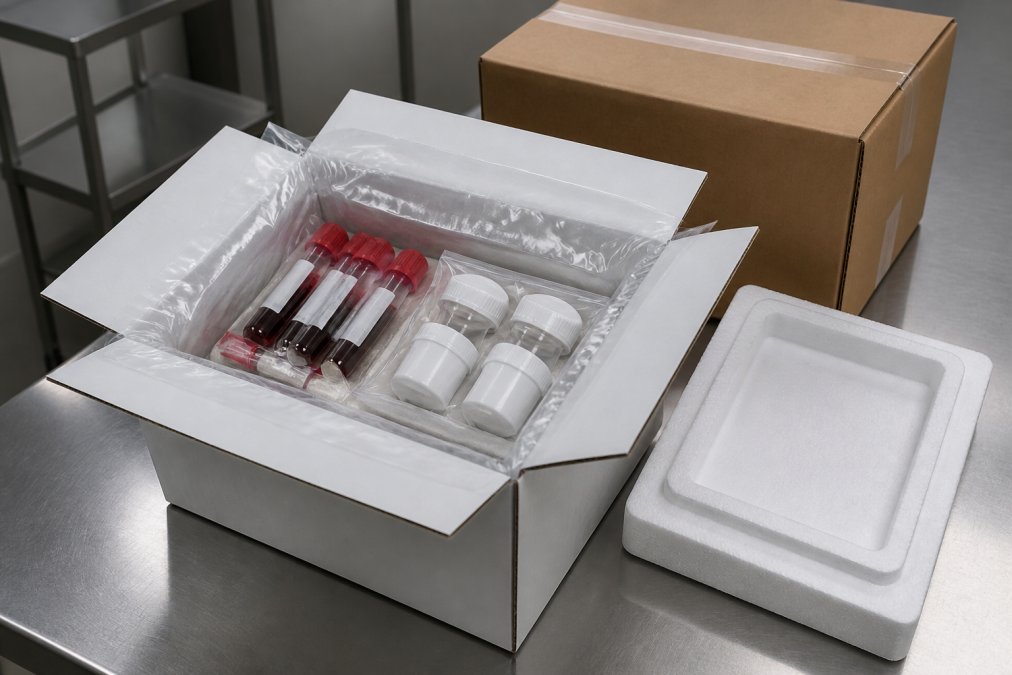
Primary, Secondary and Outer Packaging Explained
The primary container is the tube or vial holding the sample. It must be leak-proof when capped.
The secondary container is a sealed bag or rigid tub that holds the primary container. It catches anything that escapes the first layer.
The outer packaging is the rigid box that protects everything in transit. It carries the labels and absorbs knocks.
Absorbent Material and Leak Prevention
Absorbent material sits in the secondary layer. It soaks up spills so liquid never reaches the outer box. Use enough to absorb the full volume of the sample. If a tube cracks, the packaging should still arrive dry.
Clinical Sample Temperature Requirements: Keeping Specimens in Range
Clinical sample temperature requirements depend on the test. Most specimens travel at ambient, refrigerated or frozen temperatures, and each needs a different setup.
Ambient, Refrigerated and Frozen Samples
Match the packaging to the sample:
- Ambient: routine swabs and some blood tubes, kept at room temperature
- Refrigerated: samples that need 2-8°C, packed with cool packs
- Frozen: samples that need to stay frozen, packed with dry ice
Use a validated cool box, not a supermarket bag. Add a temperature indicator so the lab can see the sample stayed in range. If the reading is out of range, the lab may reject it.
Specimen Labelling and Documentation: What Must Travel With the Sample
Every sample must travel with clear labelling and paperwork. The label identifies the patient and sample; the paperwork tells the lab what to do with it.
Specimen labelling and documentation should include:
Item | What It Must Show |
|---|---|
Primary label | Patient ID, sample type, date and time |
Request form | Tests ordered, clinical details, sender contact |
Manifest | Number of samples, packaging type, temperature |
UN3373 mark | On the outer box, plus sender address |
Write labels in waterproof ink. Smudged writing is one of the top reasons labs reject a sample. Keep a copy of the manifest for your records.
Sample Transport Time Limits: How Quickly Specimens Must Reach the Lab
Sample transport time limits vary by test and stability. Some samples stay valid for hours, others for days, so check the lab’s instructions before you book.
A common approach is to send samples the same day they are taken. That keeps the sample within its stability window and gives the lab time to process it. For time-critical runs, a same-day service removes the guesswork. Our same-day express delivery is built for exactly this kind of urgent, time-sensitive consignment.
How to Brief Your Courier on Transporting Clinical Samples Safely
A good brief takes five minutes and prevents most transit problems. Tell the courier what they are carrying, how it must be handled, and who to call if something goes wrong.
Cover these points when you book:
- Sample type and category (for example, Category B)
- Temperature requirement and whether cool packs are included
- Time window the lab needs it by
- Handling rules such as keep upright, do not shake
- Contact name and number for both sender and lab
Our team at Cambridge Courier Services Ltd holds ISO9001 certification and is a member of the National Courier & Despatch Association, so the handling standards are documented and consistent. As one regular customer put it, “CCS understand our needs and are always there for us with a quick response time, friendly and professional.”
Common Mistakes to Avoid When Transporting Clinical Samples
Most failures trace back to a handful of avoidable errors. Fix these and your samples will arrive in better shape.
- Under-filling absorbent material. Use enough to soak up the whole sample volume.
- Skipping the outer box. A soft bag offers no protection against knocks.
- Smudged or missing labels. Waterproof ink and clear writing only.
- Wrong temperature setup. Match the pack to the sample, not the other way round.
- No named contact. If the lab has a question, someone must answer it.
A common mistake is treating packaging as an afterthought. In practice, it is the single biggest factor in whether a sample survives the trip.
Conclusion
Safe transport of clinical samples rests on four things: the right packaging, the right temperature, clear labelling and a realistic time window. Get those right before the courier arrives and the rest is straightforward.
If you handle sensitive or time-critical consignments, it helps to work with a courier who understands the stakes. Cambridge Courier Services Ltd offers nationwide same-day delivery, regular contract runs and 24/7 support, so your samples reach the lab in the condition they left in.
Frequently Asked Questions
How should clinical samples be packaged for transport?
Use a three-layer system: a leakproof primary container for the sample, absorbent material and a secondary leakproof bag around it, then a rigid outer box with cushioning. The secondary packaging must hold enough absorbent to soak up the entire primary contents if it breaks. Seal all layers, mark the outer box clearly, and keep the package upright. This structure is what makes clinical sample packaging requirements work in practice, whether you are sending one tube or a full rack.
Do clinical samples need to be kept at a specific temperature?
It depends on the sample. Many routine specimens travel at ambient temperature, while others need refrigeration between roughly 2°C and 8°C, and some must stay frozen. Check the receiving laboratory’s instructions for each sample type, then match the packaging to it: insulated boxes with cool packs for refrigerated items, and dry ice or validated frozen packaging where required. Clinical sample temperature requirements vary by test, so never assume one method suits everything.
How quickly should clinical samples reach the laboratory?
Most routine samples should arrive the same day they are taken, and many labs set a window of a few hours for time-critical tests. Sample transport time limits are usually set by the laboratory or the test protocol, not the courier, so confirm the deadline when you book. For urgent specimens, a same-day express service keeps the sample within its stability window and avoids the delays that come with holding samples overnight.
What information should be included on a clinical sample label?
A compliant label carries the patient identifiers, the sample type, the date and time of collection, and any handling notes such as temperature requirements. The request form travels separately in its own pouch so it stays dry and readable. Specimen labelling and documentation should be completed before the courier arrives, because a mislabelled or undocumented sample may be rejected by the laboratory and need recollecting, which delays diagnosis and wastes everyone’s time.


